A new study underscoring the need for insurer denial transparency.
CMS releasing FY 2027 IPPS and LTCH payment proposed rule.
And let the bill moratorium begin
First, a quick snapshot of where things stand at the Arizona Legislature:
Session days: 93
Bills introduced: 1,966
Bills passed: 105
Bills vetoed: 42
Bills signed: 63
On Monday afternoon, Governor Hobbs announced that she will not sign any additional bills until Republican leadership releases a budget and begins negotiations, signaling a potential slowdown in legislative activity.
We’ve seen this approach before. Most recently, last session’s standoff over funding for Arizona’s Division of Developmental Disabilities (DDD) program brought the process to a halt until both sides returned to the table.
Before making the announcement, the Governor cleared her desk — acting on all pending legislation.
That included HB2177 - AHCCCS; waivers; American Indians; services, a bill we’ve been tracking closely and supporting, which has now been signed into law.
For now, several of AzHHA’s priority bills remain alive, but the budget standoff has largely paused their progress, with third readings and final votes on hold.
It’s unclear how long this pause will last, but historically, these moments tend to break once budget negotiations begin in earnest, which should bring renewed momentum and reassurance for stakeholders.
The bottom line: Expect a slower pace at the Arizona Capitol in the short term, followed by rapid movement once an agreement is reached.
We’ll continue monitoring developments closely and keep you updated as things start moving again, reinforcing our commitment to keeping you informed.
New study underscores need for insurer denial transparency
A research letter published in JAMA Internal Medicine offers new evidence that insurer denials warrant closer scrutiny from policymakers and regulators.
Reviewing more than 51,000 closed external appeal cases in New York, the study found that independent reviewers overturned insurer denials in 52.5% of cases in 2025, up from 38.0% in 2019.
The study suggests that many denials may reflect not just appropriate utilization management, but also errors, outdated clinical criteria, ambiguous coverage rules or inappropriate insurer behavior.
Overturn rates were especially high for home healthcare (78.4%) and substance use or addiction treatment (61.5%).
According to the study’s authors, the increasing volume of appeals and growing percentage of overturned denials suggest that internal insurer review processes may not be working effectively.
The study concluded that “a robust external appeal process may help mitigate harms for those who engage with the claims system,” and “[p]olicymakers should monitor external appeal outcomes and identify opportunities for targeted oversight within the broader claims processing regulatory ecosystem.”
Relatedly, AzHHA is pursuing SB1628, which would require insurers to report data on medical claims denials and prior authorization denials to the Arizona Department of Insurance and Financial Institutions (DIFI).
DIFI would then publish an annual public report and share it with key legislative leaders, creating a clear factual record of how often denials occur and where problems may be most acute.
In light of growing evidence that many denials do not withstand outside review, this transparency is a vital first step toward future reforms.
AzHHA members are encouraged to contact their legislators and urge support for SB1628.
CMS releases FY 2027 IPPS and LTCH payment proposed rule
Last week, the Centers for Medicare and Medicaid Services (CMS) released the FY 2027 proposed rules for the hospital inpatient prospective payment systems (IPPS) and long-term care hospital (LTCH) prospective payment system (PPS).
FY 2027 IPPS proposal:
Increase IPPS payments by a net 2.4%, reflecting a 3.2% market basket update reduced by a 0.8 percentage point productivity cut.
Expand the Comprehensive Care for Joint Replacement (CJR) Model nationwide as a mandatory program, placing hospitals at financial risk for hip, knee and certain ankle replacement episodes.
Hospitals participating in the Transforming Episode Accountability Model (TEAM) would be excluded.
Reduce disproportionate share hospital (DSH) payments by approximately $564 million.
Adopt eight and remove three measures in the Inpatient Quality Reporting Program.
FY 2027 LTCH PPS proposal:
Increase LTCH payments by a net 2.3%, reflecting a 3.2% market basket update reduced by a 0.8 percentage point productivity cut.
Standard LTCH rate would increase from $50,824 to $52,177.
Maintain the high-cost outlier fixed-loss threshold at $78,936.
Remove two COVID-19 vaccination measures from the LTCH Quality Reporting Program.
Shorten LTCH QRP data submission timelines from 4.5 months to 45 days after the end of the performance period.
What’s next: AzHHA members should be on the lookout for a more detailed analysis of the proposed rule in the coming days, including facility-specific estimated impacts.
Hospitals may report feedback on the proposed rules to AzHHA’s Director of Financial Policy and Reimbursement Amy Upston.
CMS is accepting comments on the rules until Tuesday, June 9, 2026.
A recent analysis by the Center on Budget and Policy Priorities has found that Arizona’s SNAP enrollment fell 32% between the enactment of H.R. 1 in July 2025 and February 2026, the steepest decline in the nation and far above the 6% national average decline.
The Arizona Department of Economic Security (DES) data paint an even starker picture, showing that well over 400,000 Arizonans, including about 180,000 children, have lost SNAP benefits since July, an alarming drop of nearly 47%.
Arizona officials have attributed the enrollment decline in part to rapid implementation of H.R. 1.
The law expands SNAP work requirements, eliminates eligibility for certain immigration categories, reduces the federal share of SNAP administrative costs beginning in federal fiscal year 2027 and imposes significant new fiscal pressure on states to reduce payment error rates and administrative costs.
DES has estimated that Arizona’s payment error rate for federal fiscal year 2025 will be approximately 10.45%.
Pressure is on Arizona to reduce its SNAP error rate to below 6% in order to avoid hundreds of millions of dollars in penalties in federal fiscal year 2028.
Arizona’s sharp decline in SNAP enrollment may offer an early preview of the risks Arizona could face when Medicaid work requirements take effect in January 2027.
While DES’s experience does not necessarily mean the Arizona Health Care Cost Containment System (AHCCCS) will see coverage losses on the same scale, it may be a significant warning sign.
Experience with Medicaid work requirements in other states before the H.R. 1 mandate suggests that coverage losses often stem less from true ineligibility than from administrative barriers.
To the extent that Arizona’s SNAP decline reflects administrative difficulties rather than the correction of eligibility errors, a similar pattern could emerge in Medicaid.
To mitigate unnecessary coverage losses, AHCCCS will need to prioritize methods of reducing administrative barriers and burdens in its design and implementation of the community engagement requirements.
🎙 AzHHA President and CEO Ann-Marie Alameddin connects the dots during her interview with KJZZ’s The Show this week. Listen here.
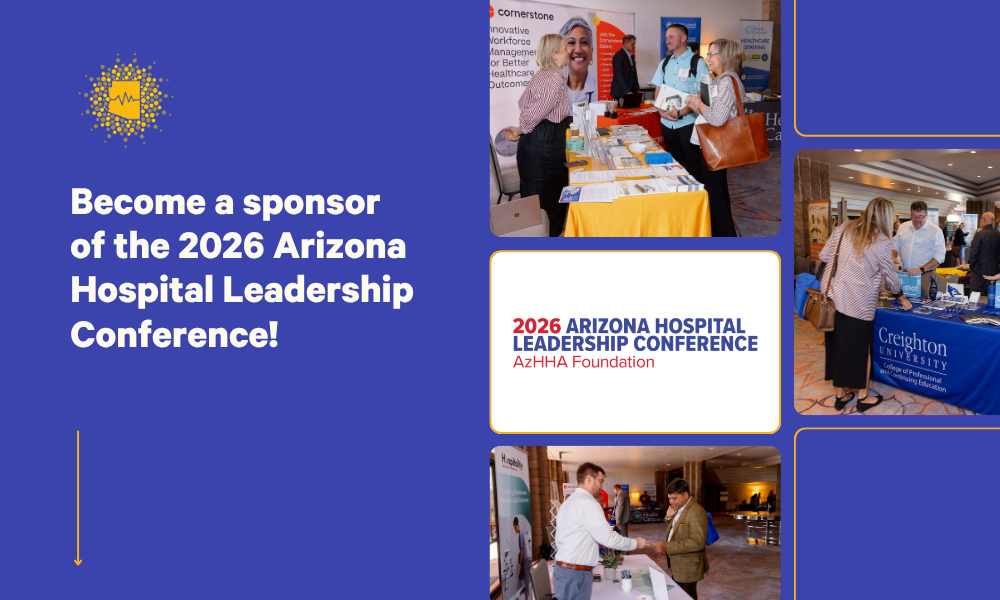
2026 Arizona Hospital Leadership Conference Sponsorship Prospectus now available
Join this year’s Sponsorship Program for the 2026 Arizona Hospital Leadership Conference, Oct. 21-23 in Tucson, Ariz., and have the enhanced ability to reach more than 200 hospital and healthcare industry leaders.
Choose from bundled options at the Title, Quality Awards Luncheon, Platinum, Gold or Silver level, or select an a la carte Bronze option.
The big picture: By sponsoring the AzHHA Foundation’s 2026 Arizona Hospital Leadership Conference, you will have opportunities to:
Gain corporate exposure and brand visibility with healthcare decision-makers.
Secure exclusive, high-impact networking time with hospital executives in an intimate setting to build meaningful connections.
Attend conference sessions, including keynote and breakout sessions on Thursday and Friday.
Achieve insight into Arizona’s healthcare community, including strengths and issues.
Support hospitals’ delivery of quality care.
Go deeper: View the entire prospectus here and access the Intent to Sponsor Form here.
🏆We’re honored — and we could use your vote
AzHHA has been nominated by the Arizona Capitol Times for Best Industry Trade & Professional Association in the 2026 Best of the Capitol awards.
Why it matters: This recognition reflects the collective work of our members and partners to advance health and healthcare across Arizona at the Capitol and in communities statewide.
What you can do: Voting is open now through Friday, May 1, 2026, and we’d be grateful for your support.
Winners will be announced at the Best of the Capitol awards celebration on Wednesday, June 3, 2026, in downtown Phoenix.
Naloxone Leave Behind Program
The Arizona Department of Health Services (ADHS) is continuing its partnership with the Substance Abuse and Services Administration (SAMHSA) to support the ADHS Naloxone Leave Behind Program for EMS agencies across the state.
Why it matters: Through this program, ADHS provides naloxone leave-behind kits and training at no cost to participating EMS agencies.
What’s next:
If your agency is already a participating partner and needs to order additional kits, please contact the program coordinator at david.hanson@azdhs.gov.
If you are an EMS agency interested in becoming a partner and distributing naloxone leave-behind kits, please visit this website.
From crisis to readiness: Emergency preparedness webinar
In 2023 and 2025, the Maui, Palisades and Eaton fires forced urgent evacuations that tested emergency preparedness plans across the healthcare system and challenged hospitals, nursing homes, public health agencies and emergency responders.
The Health Services Advisory Group is hosting a webinar on Friday, May 15, 2025, to bring together firsthand insights on what worked, where challenges emerged and how lessons learned can strengthen emergency preparedness across all provider types.
Who should attend?
Hospitals, nursing homes, clinics and other healthcare providers
Health departments, emergency preparedness partners and other stakeholders
Wednesday, April 24, 2026 - AzPHA Convos & Coffee: Soundbites vs. Science: Spotting Logical Fallacies in Public Health Debates Join the Arizona Public Health Association (AzPHA) for a virtual discussion with Greg Loeben, Ph.D., MPH. Learn to recognize the logical fallacies and misleading tactics behind health misinformation so you’re ready to respond when it matters most. Register here.
Monday, April 27, 2026, Wednesday, April 29, 2026 and Thursday, April 30, 2026 - Getting started with AHCCCS Solutions Center webinar The Arizona Health Care Cost Containment System (AHCCCS) is launching a AHCCCS Solutions Center, a new, centralized platform designed to make it easier to connect with AHCCCS and submit requests on behalf of providers. This webinar will introduce this new platform and walk participants through the initial setup process. Register for one session: Monday, April 27; Wednesday, April 29 or Thursday, April 30.
Thursday, April 30, 2026 - AzAHQ 2026 Spring Virtual Conference: Quality’s Role in Organizational Culture Join the Association for Healthcare Quality of Arizona (AzAHQ) to explore the role of quality leadership in fostering a culture of safety and quality within organizations from the boardroom to frontline employees. This conference will explore the critical interrelationship between quality and financial outcomes, distinguish between traditional, siloed quality models and a true enterprise-wide culture of quality, understand quality’s role in healthcare violence prevention and staff safety, and action plan development. Register now.
Friday, May 1, 2026 - From Crisis to Care: Improving Outcomes in Arizona’s Behavioral Health System The Arizona Public Health Association’s 98th Annual Conference will focus on strengthening Arizona’s behavioral health system and improving outcomes for people with mental and behavioral health needs. This year’s conference will highlight innovative strategies, evidence-based practices and policy approaches that move the system beyond crisis response and toward sustainable, person-centered care. Learn more and register.
June 9-10, 2026 - 2026 AzCHER Healthcare Emergency Preparedness Conference This year’s theme is “Many voices, one mission: Advancing healthcare preparedness together.” The one-and-a-half-day conference features sessions shaped by member feedback and brings together experts across healthcare, public health and emergency management. Register now.
Save the Date: 2026 Arizona Hospital Leadership Conference Mark your calendar for the AzHHA Foundation’s 2026 Arizona Hospital Leadership Conference, taking place Oct. 21–23 at the El Conquistador Tucson, a Hilton Resort. This annual gathering brings together hospital and healthcare leaders from across the state for engaging discussions, networking and forward‑focused learning. Additional details and registration information will be shared in the coming months. Questions may be directed to communications@azhha.org.