Remember, the event is taking place Oct. 21-23, 2026, at the El Conquistador Tucson, a Hilton Resort.
The big picture: View the 2-and-a-half day conference agenda here, including breakout sessions tracks with best practices in care excellence and patient safety, financial strategy and sustainability, and innovation and artificial intelligence.
Don’t delay!Register by Wednesday, Sept. 2, 2026, to take advantage of the early bird discount.
⌛Time is running out to apply for the Creighton University Emerging Leaders in Healthcare Scholarships
Applications for the Creighton University Emerging Leaders in Healthcare Scholarship opportunity are due by Sunday, Aug. 30, 2026.
Two scholarships will be awarded to selected applicants for the 2026 Arizona Hospital Leadership Conference, Oct. 21-23, 2026, at the El Conquistador Tucson, a Hilton Resort.
Each scholarship will assist with registration, travel and accommodations during the conference up to $2,500.
Why it matters: The scholarships support emerging and dedicated professionals working in underserved healthcare settings to attend this premier statewide event.
The goal is to promote leadership development, professional growth and the exchange of innovative practices among healthcare professionals across the state of Arizona.
What’s next: Review the application for complete details on what the scholarships include, who is eligible and how to apply.
Submit the application by the deadline Sunday, Aug. 30, 2026.
Prior authorization metrics provide new insights into insurer practices, but gaps remain
Why it matters: New federal reporting requirements are shedding light on how health insurers use prior authorization, offering the most detailed view yet into approval rates, denials, appeals and response times across Medicare Advantage, Medicaid managed care and Affordable Care Act (ACA) Marketplace plans.
Insurers denied 12% of standard prior authorization requests in Medicare Advantage, 14% in Medicaid managed care and 18% in ACA Marketplace plans.
While denials are rarely appealed, many are overturned when challenged. Appeal reversal rates reached 67% in Medicare Advantage, 47% in Medicaid managed care and 43% in ACA Marketplace plans.
Median response times were generally about one day for standard requests and even faster for expedited requests.
Yes, but: Significant reporting gaps remain.
Data are aggregated, making it difficult to determine which services are most frequently denied, and insurers use inconsistent reporting formats that limit public understanding and comparison.
The bottom line: Greater transparency is a step forward, but more standardized and detailed reporting will be needed to fully evaluate prior authorization practices and their impact on patient care.
Why CMS’ Medicaid waiver pullback matters to providers
Why it matters: The Centers for Medicare and Medicaid Services (CMS) is scaling back the use of Medicaid Section 1115 waivers, a key policy tool states use to test new coverage models, workforce initiatives and payment reforms.
The changes could have significant implications for providers, state budgets and Medicaid innovation.
What's happening:
CMS has limited support for certain waiver programs, including workforce development and continuous enrollment initiatives, while also tightening oversight of waiver approvals and renewals.
New budget neutrality requirements are expected to make waiver approvals more rigorous and could slow the review process.
Why providers should care:
Many waivers have funded workforce recruitment and retention, behavioral health services and care delivery transformation efforts. Reduced waiver flexibility could limit these investments and strain provider finances.
States may have fewer options to address provider shortages and healthcare access challenges through Medicaid.
The bottom line: As CMS narrows the scope of Medicaid 1115 waivers, providers and states may face fewer opportunities to innovate, potentially impacting workforce capacity, reimbursement and patient access to care.
Go deeper: Read this article from Modern Healthcare (subscription required).
ADHS update: Continuation of current immunization schedules and guidelines
On Monday, Aug. 10, 2026, a federal Executive Order titled “Delivering Gold-Standard Childhood Vaccine Recommendations for Americans” was issued.
Yes, but: At this time, the vaccine recommendations of the Arizona Department of Health Services (ADHS) remain unchanged, and all vaccines continue to be available.
Currently, there are no changes to school or child care immunization requirements and related provisions or to the Vaccines for Children (VFC) program.
What they are saying: ADHS remains committed to providing evidence-based public health guidance and recommendations to our healthcare community and the public, while ensuring access to vaccinations to help reduce costs to Arizonans and prevent injury and illness associated with vaccine-preventable diseases.
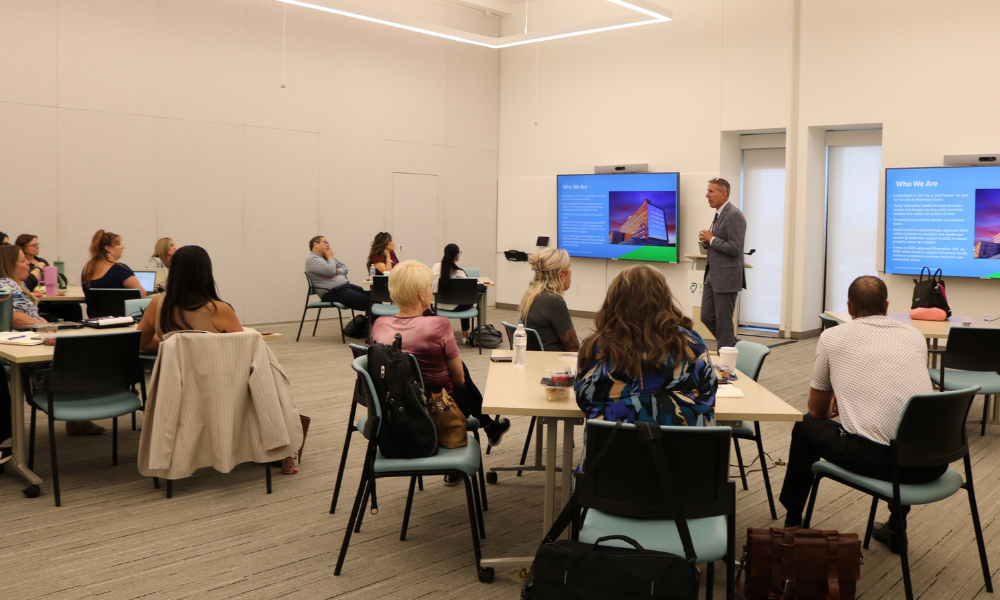
The Healthcare Leadership Academy (HLA) held its midpoint session last week at Valleywise Health, bringing participants together for an in-person learning session focused on leadership, evidence-based decision-making and community building at a member hospital.
Why it matters: Through a partnership between the AzHHA Foundation and Creighton University's College of Professional and Continuing Education, the HLA helps cultivate leadership within AzHHA member hospitals and prepare the next generation of healthcare executives.
The session provided participants with opportunities to strengthen leadership skills, make informed decisions and connect with peers from hospitals across Arizona.
A team simulation exercise gave participants hands-on experience navigating real-world leadership scenarios.
The afternoon featured a presentation from Michael White, M.D., MBA, president and CEO of Valleywise Health, who shared perspectives on the organization's future.
Dr. White highlighted the importance of innovation and patient-centered care as key priorities moving forward.
Tour highlights: Participants wrapped up the day with a tour of Valleywise Health's new facility, including its state-of-the-art Burn Center.
The tour showcased Valleywise Health's commitment to advanced healthcare services and provided a firsthand look at the facility's modern capabilities.
At least 37 states have Medicaid state directed payments for hospital services that could be reduced by the 2025 reconciliation law limits
Why it matters: A new KFF analysis finds that at least 37 states, plus Washington, D.C., have Medicaid state-directed payment (SDP) programs for hospital services that could be significantly affected by new limits included in the 2025 reconciliation law.
These changes could reduce a major source of Medicaid funding for hospitals, particularly safety-net providers.
What's happening:
The 2025 reconciliation law includes new restrictions on SDP arrangements, which states use to direct Medicaid managed care plans to pay hospitals above traditional Medicaid rates.
KFF estimates roughly $60 billion in federal Medicaid spending for hospital SDPs exceeds the new limits and could be reduced over time as the policy is phased in.
Historically, some states have set payments as high as commercial insurance rates; the new law generally caps them closer to Medicare payment levels.
The impact: States may need to redesign payment programs, while hospitals, especially rural and safety-net facilities, could face financial pressure if supplemental funding declines.
The bottom line: The new federal limits could reshape Medicaid hospital financing nationwide, creating budget and operational challenges for states and providers alike.
Arizona’s early West Nile virus season
Arizona is experiencing an unusually early and active West Nile virus (WNV) season.
The Arizona Department of Health Services shared that as of Tuesday, Aug. 11, 2026, the state has reported 73 human cases, more than three times the five-year median of 24 cases reported during January to July.
This season, cases of WNV in Arizona were identified starting in April, a month earlier than previous seasons.
Why it matters: Healthcare providers should maintain a high index of suspicion for WNV and other mosquito-borne arboviral infections, particularly among patients with neurologic illness and those who are immunocompromised or receiving B-cell-depleting or modulating therapies, who may have delayed or absent antibody responses.
Duffy Group, an AzHHA affiliated partner, recently had an article published about how a more informed approach can help organizations make stronger leadership decisions while reducing the likelihood of costly mis-hires.
Why it matters: Executive hiring carries bigger consequences than ever and mis-hires are both common and costly.
An “informed search” reduces risk by grounding decisions in market intelligence, stakeholder alignment and shared accountability.
The big picture: Roughly one-third to one-half of senior external hires fail within 18 months—mostly due to misaligned expectation, poor fit or unclear success criteria.
Informed search aims to rebalance risk through transparency, data and upfront clarity.
The bottom line: Executive hiring is now a business-risk decision.
Organizations that invest in clarity, data and communication up front can make stronger leadership choices—and avoid the high cost of getting it wrong.
For more information, AzHHA members can contact Duffy Group’s Chief Revenue Officer Melissa Barker at mbarker@duffygroup.com.
UPCOMING EVENTS
Friday, Sept. 4, 2026 – Deadline for AzPHA Public Health Awards nominations The Arizona Public Health Association (AzPHA) is accepting nominations for its 2026 Public Health Awards to recognize the people and organizations whose dedication, leadership, service and impact deserve to be celebrated. The awards ceremony will be held on Thursday, Oct. 29, 2026, at The Social Hall in Tempe. Submit your nomination today.
Friday, Sept. 11, 2026 and Saturday, Sept. 12, 2026 – Alzheimer’s and Dementia in Practice: Bridging the Gap Between Diagnosis and Treatment Yavapai County Community Health Services is hosting two free, three-hour professional development classes in Cottonwood and Prescott to learn from medical experts in the field of Alzheimer’s and dementia on how to bridge the gap between early diagnosis and effective treatment by improving screening practices and connecting patients and caregivers with valuable resources. Register here for the Cottonwood session on Sept. 11 and register here for the Prescott session on Sept. 12.
Sept. 12, Sept. 19 and Oct. 3, 2026 – AzNA Regional Townhalls Join the Arizona Nurses Association (AzNA) for its regional townhalls in September and October. Townhalls will be held in Phoenix, Flagstaff and Yuma. Board reports and networking will take place at all three events, and the full business meeting (including the induction of new board members) will occur in Phoenix. Learn more and register.
Oct. 21-23 – 2026 Arizona Hospital Leadership Conference The 2026 Arizona Hospital Leadership Conference will be held at the El Conquistador Tucson, a Hilton Resort on Oct. 21-23. This will be an inspirational gathering of more than 200 hospital and healthcare executives seeking opportunities for continuing education, meaningful discussion and relationship building. Registerby Wednesday, Sept. 2, 2026, to receive the early bird discount.