Election results that begin to shape the agenda for the 2027 legislative session.
Legislative leaders selected ahead of the 2027 session.
Apply now for the next cohort of the Healthcare Leadership Academy.
Election results set stage for 2027 session
Driving the news: A week after Election Day, nearly every Arizona race has been called.
The Legislature:
The Associated Press called the Senate for Democrats early last week and the House on Friday, Nov. 6.
Democrats are on track to hold 20 of 30 Senate seats and 37 of 60 House seats.
That gives Democrats two-thirds of the Senate. In the House, they are three votes short of the 40 needed for emergency clauses and tax increases, so Republican votes still count there.
Statewide: Democrats swept the statewide offices. Along with governor, attorney general and secretary of state:
Treasurer: Nick Mansour
Superintendent of public instruction: Teresa Leyba Ruiz
Mine inspector: Brian Matlock, the first Democrat to win the office since 1976
Corporation Commission: Clara Pratte and Jonathon Hill won both open seats. Pratte becomes the first Native candidate to win statewide office in Arizona.
Congress: All nine races have been called. Democrats now hold a 5-4 majority of Arizona's U.S. House seats, up from a 6-3 Republican advantage.
Flipped: Congressional District (CD) 1 (Amish Shah) and CD6 (JoAnna Mendoza)
Republicans held: CD2 (Rep. Eli Crane, called Monday, Nov. 9, 2026), CD5 (Mark Lamb), CD8 (Rep. Abe Hamadeh) and CD9 (Rep. Paul Gosar)
What it means for hospitals:
With the Governor's Office and both chambers, Democrats will lead negotiations on the FY2028 budget, including Arizona Health Care Cost Containment System funding.
Democrats can pass emergency-clause bills in the Senate on their own, but in the House, they need at least three Republican votes, so bipartisan relationships remain essential.
Health committee chairs, once named, will decide which hospital bills get a hearing, so early outreach to them is a top priority.
What's next:
Results become official at the Monday, Nov. 23, 2026 statewide canvass.
Committee chairs and assignments haven't been announced yet. We'll share them as soon as they're released.
Session convenes Monday, Jan. 11, 2027.
Legislative leaders set ahead of 2027 session
All four legislative caucuses have chosen their leaders for the 58th Legislature.
Why it matters: These leaders will set the agenda on the budget, Arizona Health Care Cost Containment System and health policy.
The incoming speaker and senate president will also pick the committee chairs who decide which hospital bills get a hearing.
House majority
Speaker: Oscar De Los Santos (Dist. 11), the first Democratic Speaker since 1966
Speaker pro tempore: Quantá Crews (Dist. 26)
Majority leader: Nancy Gutierrez (Dist. 18)
Majority whips: Brian Garcia (Dist. 8) and Kevin Volk (Dist. 17)
House minority
Minority leader: Steve Montenegro (Dist. 29), the current Speaker
Assistant minority leader: Michael Carbone (Dist. 25)
Minority whip: Lupe Diaz (Dist. 19)
Senate majority
President: Priya Sundareshan (Dist. 18)
Majority leader: Christine Marsh (Dist. 5)
Majority whip: Analise Ortiz (Dist. 24)
Presidents pro tempore: Alma Hernandez (Dist. 20) and Edgar Soto (Dist.17)
Minority leader: John Kavanagh (Dist. 3), the current Majority Leader
Assistant minority leader: Tim Dunn (Dist. 25)
Minority whip: Leo Biasiucci (Dist. 30)
Deputy assistant minority leader of communications: Mark Finchem (Dist.1)
The bottom line: Leadership is set in both chambers.
AzHHA will meet with leaders of both caucuses ahead of session to advance hospital priorities.
Apply now: Healthcare Leadership Academy
Applications are currently being accepted for the 2027 cohort of the Healthcare Leadership Academy (HLA).
The AzHHA Foundation partners with Creighton University’s College of Professional and Continuing Education to provide healthcare leadership and management education to rising leaders within AzHHA member hospitals.
What you need to know: Nine months of learning begins in March 2027 and culminates in November 2027 which includes three in-person sessions and four hours of synchronous virtual attendance required on the second Thursday of April, May, June, July, September and October.
The HLA is geared toward mid-level managers and early-stage executives to prepare them for C-suite positions.
The big picture: This is fourth cohort of the HLA. Learn more about the program here.
What’s next: To apply, submit your resume, letter of support and statement of purpose in one PDF to MemberServices@azhha.org by 5 p.m. on Monday, Nov. 30, 2026.
If you have any questions, please contact Laura Dickscheid, vice president of member services and 2024 HLA participant, at MemberServices@azhha.org.
9 things to watch for the 2027 ACA Open Enrollment period
What’s happening: Premiums are rising by an average of 13%, enrollment continues to decline following the expiration of enhanced tax credits and more insurers are exiting Marketplace plans in some states.
Some states, including California and New Mexico, are using state-funded subsidies to offset lost federal assistance.
What to watch: New anti-fraud measures may reduce enrollment assistance, some lawfully present immigrants will lose subsidy eligibility, Medicaid work requirements could limit access to Marketplace subsidies and ongoing litigation may delay or reverse certain enrollment and coverage changes.
The bottom line: Consumers may face higher costs, fewer plan choices and more complexity when selecting coverage in 2027.
Epic’s growing influence draws scrutiny
Why it matters: As AI-powered healthcare tools expand, access to patient data is becoming a key competitive advantage.
What’s happening: A STAT investigation examines whether Epic Systems' dominance in the electronic health record (EHR) market is limiting innovation.
Competitors and hospital leaders allege Epic uses its control over health data and software integrations to disadvantage rival products and steer customers toward its own solutions.
The debate: Epic says it exceeds federal data-sharing requirements and supports a broad ecosystem of technology partners.
Critics argue the company’s market power gives it outsized influence over which digital health and AI tools succeed.
The bottom line: The findings are likely to intensify antitrust and competition concerns across the health technology sector.
Go deeper: Read this article from STAT News (subscription required).
CMS expands access to minimally invasive heart valve procedure
Why it matters: More Medicare beneficiaries could gain access to a less invasive treatment for severe aortic stenosis, a common and potentially life-threatening heart condition.
What’s happening: The Centers for Medicare and Medicaid Services (CMS) finalized changes to coverage requirements for transcatheter aortic valve replacement (TAVR), easing restrictions on where the procedure can be performed.
The update allows more hospitals to qualify, potentially increasing patient access, particularly in underserved areas.
The impact: Hospitals and device manufacturers welcomed the move, arguing it reflects advances in clinical evidence and provider experience.
Supporters say broader access could reduce travel burdens and speed treatment for eligible patients.
The bottom line: The policy change is expected to expand Medicare patients’ access to TAVR while giving more hospitals the opportunity to offer the procedure.
Go deeper: Read this article from Modern Healthcare (subscription required).
Member spotlight: Sage Memorial Hospital
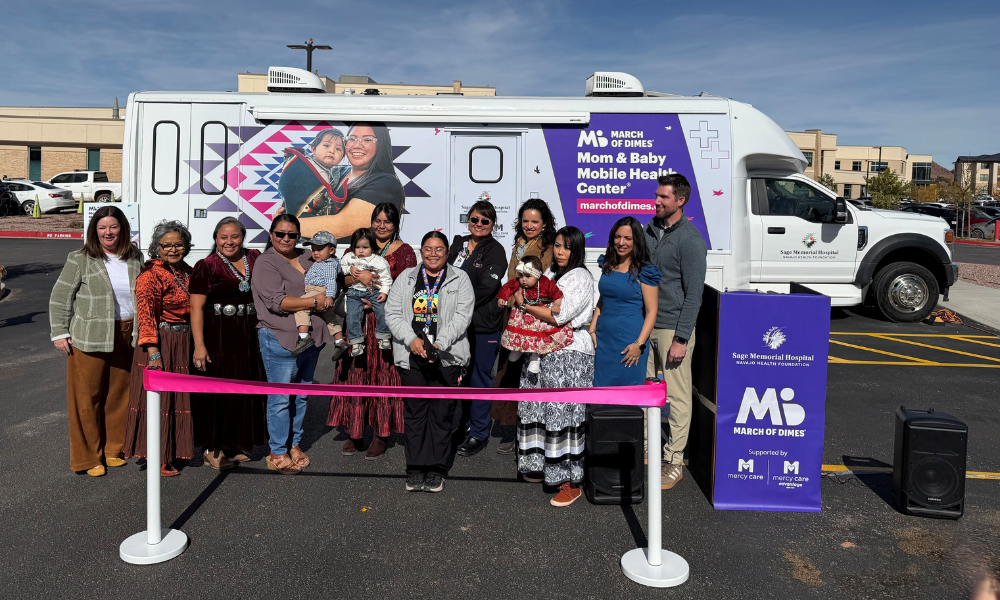
On Tuesday, Nov. 10, 2026, Sage Memorial Hospital held its Mom and Baby Mobile Health Center Grand Opening.
Why it matters: The new center brings care closer to home for families across the Navajo Nation in Arizona.
From pregnancy through the months after birth, the team cares for moms and babies together, so families can get the care they need without long drives to a clinic.
The big picture: The mobile center is a partnership between Sage Memorial Hospital, March of Dimes, Mercy Care and the Mercy C.A.R.E.S. Community Reinvestment Program.
Go deeper:Learn more about the Mom and Baby Mobile Health Center.
UPCOMING EVENTS
Tuesday, Nov. 17, 2026 – AZ Maternal and Child Health Workforce and Policy Summit – Building the Workforce. Shaping Policy. Supporting Families. Join leaders across Arizona’s maternal and child health ecosystem for a day of learning, connection and action focused on strengthening care from pregnancy through early childhood. This year’s summit will focus on workforce, policies, partnerships and care pathways needed to better support families from pregnancy through postpartum, infancy and early childhood. Register now.
Dec. 11-13, 2026 – AzAHQ’s Quality Journey Course: A Path to Certification The field of healthcare equality and the healthcare quality professional’s role are expanding exponentially in today’s ever-changing healthcare climate. This course is designed for healthcare professionals who are interested in learning more about healthcare quality and preparing for certification. Learn more and register.
Jan. 8-9, 2027 – 3rd National Pediatric Disaster Conference The conference, which will be held in Scottsdale, Ariz., will focus on pediatric mass casualty incidents and innovative approaches to strengthening preparedness, response and recovery efforts for children. AzCHER encourages members to attend and take advantage of this opportunity to learn, connect and strengthen pediatric readiness. Register today.