The end of the legislative session at the Arizona Capitol.
A new offering — a Clinical Leadership Certificate Program.
CMS tightening 1115 waivers.
All quiet on the Capitol front
The Arizona Legislature completed its work in the early hours of Saturday, June 13, 2026, with the Senate adjourning around 12:30 a.m. and the House adjourning at roughly 4:45 a.m.
A contentious, marathon floor session pushed the final adjournment well into the morning, fitting of a long session.
How did Arizona’s hospitals fare this session? Overall, well. AzHHA and its partners across the healthcare community made meaningful progress on several priorities. Among the session’s most notable wins:
HB2049 (radiation therapy; rural counties): Authorizes the use of particle accelerators for radiation therapy under general supervision in counties with fewer than 400,000 residents or in critical access hospitals.
Signed by Governor Hobbs and became law on June 4, 2026 (emergency clause).
HB2176 (health facilities; licensure; complaints; investigations): Bars operators with problematic compliance histories from obtaining or transferring hospital licenses and establishes procedural safeguards for licensees facing Arizona Department of Health Services (ADHS) investigations.
Signed by Governor Hobbs on June 4, 2026.
HB2177 (AHCCCS; waivers; American Indians; services): Restores Arizona Health Care Cost Containment System (AHCCCS) coverage for services previously eliminated for Native American members at tribal and Indian Health Services facilities, including dental services.
Signed by Governor Hobbs on April 13, 2026.
SB1162 (health care institutions; licensing; complaints): Directs ADHS to coordinate with AHCCCS on monitoring and compliance functions to reduce overlap and duplication. It also defines the role of a behavioral health technician in acute care settings and clarifies workforce requirements.
A win for regulatory leadership: The Senate also confirmed permanent directors at two agencies central to hospital regulation:
Debbie Johnston, director, Arizona Department of Health Services (ADHS). A former AzHHA executive vice president, Director Johnston brings deep regulatory expertise and a collaborative record with Arizona’s providers. ADHS had been without a Senate-confirmed director since 2021.
Charles “Chuck” Bassett, director of the Department of Insurance and Financial Institutions (DIFI), brings more than three decades of experience in public policy and insurance regulation to the department.
Stable, confirmed leadership at both agencies is a welcome development for AzHHA and the broader healthcare community.
Budget wins: AzHHA worked hard to secure several critical components during this year’s budget negotiations. Notable wins include:
Critical access hospitals (CAH) — $4.4 million: A one-time continuation of supplemental funding that draws down federal matching dollars and replenishes the CAH supplemental pool for eligible hospitals.
AHCCCS and Department of Economic Security implementation — $51.5 million and $10.8 million: One-time allocations to implement requirements under Public Law 119-21 (the federal budget reconciliation law, H.R. 1).
Traditional healing services pilot: A three-year pilot program to provide coverage for traditional healing services, contingent on federal approval.
Graduate Medical Education (GME): More than $4 million saved.
988 crisis line: Continued support for Arizona’s 988 Behavioral Health Crisis Services hotline.
Access to perinatal and pediatric psychiatry: $1.2 million from the University of Arizona General Fund to support the Arizona Perinatal and Pediatric Psychiatry Access Line.
What’s next: AzHHA’s Policy and Advocacy team is already planning for 2027.
Several priorities remain on our unfinished-business list, and we fully intend to return to them when the Legislature reconvenes in January.
Reach out to Damien Johnson, director of government relations, with any suggestions or questions.
Thank you to our members for your dedication this session in advocating sound hospital policy and helping educate lawmakers on the issues that matter most to Arizona’s healthcare system.
Together, we defeated several unfunded mandates and proposals that would have exposed providers to new compliance risks.
None of this would have been possible without the leadership teams at our member hospitals.
Thank you for being available, engaged and our go-to resource as we continue to represent you at the state and federal levels.
New offering: Clinical Leadership Certificate Program
AzHHA is partnering with Creighton University’s College of Professional and Continuing Education to offer a Clinical Leadership Certificate Program.
Why it matters: We’re proud to continue to help bolster leadership at healthcare organizations across Arizona.
This new iteration engages both nurses and other non-nursing clinical leaders.
The Clinical Leadership for Change & Culture Certificate, A Human-Centered Approach to Leading Teams, Systems and Change, is a 10-week online program designed for emerging clinical leaders ready to step into high-impact roles.
The big picture: The July 2026 cohort runs from Monday, July 6 to Friday, Sept. 11, 2026, with two hours of engagement each week and facilitator-led discussion boards weekly.
Note: The total time commitment is 16 hours, as two flex weeks are built into the cohort schedule.
The deadline to sign up for this cohort is Monday, June 29, 2026.
If you’re interested in signing up for the program or if you have additional questions, please email ttpprogram@azhha.org.
On Thursday, June 11, 2026, the Centers for Medicare and Medicaid Services (CMS) issued guidance outlining updated standards for approving Section 1115 demonstration waivers.
A Section 1115 waiver allows a state to test new approaches in Medicaid by waiving certain federal rules and using federal funds for services or populations that wouldn’t otherwise be covered.
Why it matters: Taken together with the proposed SDP rule, the guidance points to a clear shift toward less flexibility and greater federal control over Medicaid spending.
What changed:
Starting Jan. 1, 2027, CMS will not approve or renew 1115 waivers unless the chief actuary certifies they will not increase federal spending.
States will need to submit more rigorous and defensible analyses, with a closer review of individual waiver components.
While CMS ties this to H.R. 1, the guidance suggests a broader shift — pointing to a more stringent approach overall, with deeper scrutiny and more detailed financial validation.
Historically, Section 1115 waivers have been required to be “budget neutral,” but that expectation was set through policy and applied with some flexibility.
H.R. 1 changes that by putting the requirement directly into statute and requiring formal actuarial certification that waivers will not increase federal spending.
CMS is now signaling it plans to apply that standard more tightly in practice.
Arizona impact: Arizona’s Section 1115 waiver expires Sept. 30, 2027, putting the state among the first to go through renewal under H.R. 1’s new requirements.
Given how central the waiver is to Arizona’s Medicaid program, that process will be an early indicator of how CMS applies these stricter standards in practice.
OIG flags MA denials in post-acute care
On Thursday, June 11, 2026, the Department of Health and Human Services Office of Inspector General (OIG) released new reports highlighting high prior authorization denials by Medicare Advantage (MA) plans for post-acute care — especially inpatient rehabilitation hospitals (IRFs) and long-term acute care hospitals (LTACHs).
Findings:
Denials vary widely across plans, with the largest Medicare Advantage Organizations (MAOs) denying services at much higher rates than peers.
CVS Health, Humana and UnitedHealth denied LTACH prior authorization requests at 80%, 72% and 71%, respectively, compared to 42% for all other MAOs.
IRF denial rates ranged from 51%–66% for the three largest MAOs, compared to 41% for all others.
A significant share of denials are later reversed:
~36% for LTACHs and ~43% for IRFs.
Recommendations: OIG recommends that the Centers for Medicare and Medicaid Services:
Collect more detailed, request-level prior authorization data.
Analyze denial and overturn patterns across plans and contractors.
Take action where patterns suggest inappropriate restrictions on care.
Why it matters: UnitedHealth, Humana and CVS Health — plans with the highest denial rates — cover approximately 70% of Medicare Advantage enrollees in Arizona.
Wide variation across MA plans suggests patients may face different outcomes depending on their insurer.
Care teams are increasingly managing appeals and resubmissions to secure post-acute placements, increasing costs and administrative burden.
A national shortage of injectable penicillin — the only recommended treatment to prevent congenital syphilis — is now affecting real patients, including cases in Arizona.
What’s happening: In July 2025, Pfizer issued a voluntary recall of Bicillin L‑A (penicillin G benzathine), the only first-line treatment for pregnant patients with syphilis.
Because there is only one U.S. manufacturer, the recall quickly led to a nationwide shortage.
The Food and Drug Administration does not expect supply to fully recover until at least December 2027.
Why it matters: Arizona has one of the highest rates of congenital syphilis in the country.
The condition is largely preventable but can result in stillbirth, infant death or lifelong disability without timely treatment.
Nationwide, congenital syphilis contributes to hundreds of fetal and infant deaths each year, underscoring the severity of a condition we know how to prevent.
A recent case in Gila County highlights the risk of supply disruptions — a pregnant patient could not obtain penicillin in time, resulting in a preventable case of congenital syphilis.
The bottom line: Without reliable access to penicillin, even well-established screening and treatment protocols may not be enough to prevent avoidable harm.
Highlights from the 2026 AzCHER conference
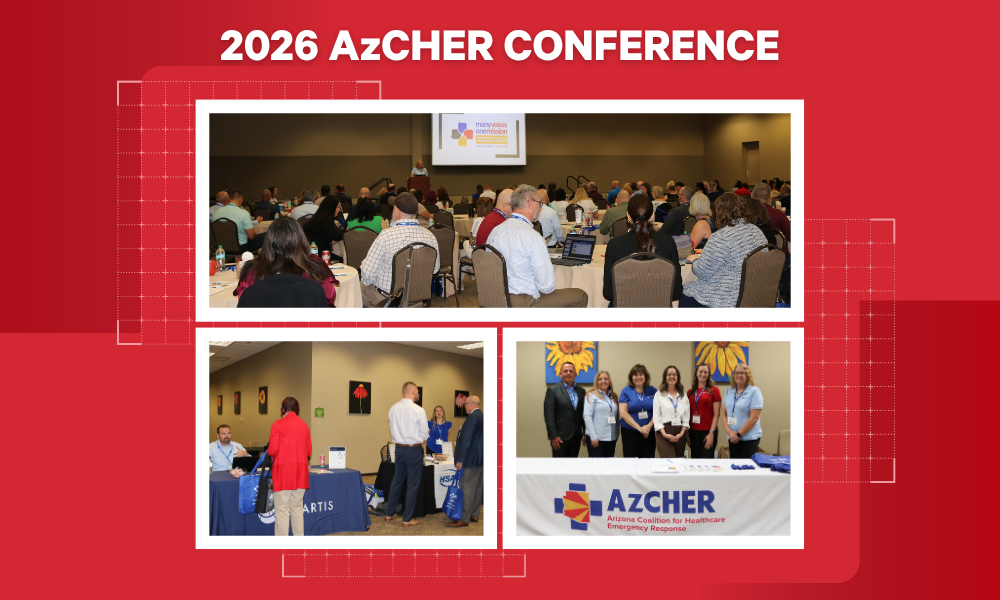
Thank you to everyone who attended the 2026 AzCHER Healthcare Emergency Preparedness Conference, where we came together to advance healthcare readiness, resilience and coordinated response across Arizona.
Why it matters: This year’s conference was shaped directly by member feedback, bringing together healthcare, public health and emergency management professionals to address emerging threats, share lessons learned and strengthen coordinated response efforts.
Attendees gained valuable insights through expert-led sessions on topics including workplace violence, behavioral threat assessment, regulatory updates and real-world response strategies.
Day two offered training and exercise development focused on enhancing prevention, response and recovery capabilities in healthcare settings.
The strong turnout and engagement reflect a continued commitment from Arizona’s healthcare community to prioritize emergency preparedness and collaboration.
A special thanks to our sponsors for their generous support and to our speakers for sharing their expertise and time.
What’s next: If you’d like to sponsor or speak at one of AzCHER’s future events, please email us at azcheradmin@azhha.org.
Stay tuned for more information on upcoming trainings and the 2027 AzCHER conference.
POLST has moved to AzHDR
The POLST program has transitioned to the Arizona Healthcare Directives Registry (AzHDR), a service of Contexture.
Why it matters: This move builds on AzHHA’s strong foundation and centralizes access to POLST information, advance care planning resources and related services.
The big picture: This integration brings POLST into the statewide healthcare directives registry, improving coordination and creating a more connected advance care planning experience for Arizonans.
Friday, July 17, 2026 - 2026 Summer State of the State Registration is now open for The Hertel Report’s Summer State of the State, hosted this year at Summit Regional Medical Center in Show Low, with virtual attendance also available. The bi-annual conference will feature updates on Arizona’s healthcare market and insights on federal and state policy impacts, including Medicare Advantage, Medicaid, the Marketplace and value-based care trends. Discounted pricing is available for AzHHA members by using “azhha2026.” Register now.
Tuesday, Sept. 1, 2026 - Sidewalk to Bedside: Reimagining Care Through Street Medicine-Hospital Partnerships Symposium Join the University of Southern California for a free, in-person one-day symposium. This event brings together street medicine experts, hospital leaders, community organizations and health plans to explore how street medicine programs and hospitals can better partner to improve care before and after hospital discharge. Learn more and register.
Save the Date: 2026 Arizona Hospital Leadership Conference Mark your calendar for the AzHHA Foundation’s 2026 Arizona Hospital Leadership Conference, taking place Oct. 21–23 at the El Conquistador Tucson, a Hilton Resort. This annual gathering brings together hospital and healthcare leaders from across the state for engaging discussions, networking and forward‑focused learning. Additional details and registration information will be shared soon. Questions may be directed to communications@azhha.org.