The federal crackdown on hospital price transparency.
The last chance to sign up for the July 2026 cohort of the Clinical Leadership Certificate Program.
Banner Health clinicians file to unionize
On Monday, June 22, 2026, the Union of American Physicians and Dentists announced that physicians, nurse practitioners and physician assistants at Phoenix-based Banner Health filed a petition for union representation.
Why it matters: If the election succeeds, the bargaining unit would include more than 240 clinicians across 31 clinic locations in the Phoenix metro area.
What’s next: A union spokesperson said the National Labor Relations Board is expected to issue an election date in July.
The Trump Administration has escalated enforcement of federal price transparency rules, issuing warning letters or corrective action requests to more than 500 hospitals nationwide since April.
While enforcement applies across all hospital types, early reports from several states suggest behavioral health and other specialized facilities may be more affected, often due to technical and formatting requirements under the updated rules.
What’s changing: With the “grace period” ending in March 2026, hospitals are now expected to post complete, accurate pricing data or face penalties.
New 2026 requirements require claims-based pricing data (not estimates) and more standardized machine-readable files.
Fines are calculated on a per-day basis and tied to hospital size (bed count).
Why it matters: Compliance now depends on accurate data and file formatting, not just meeting policy requirements.
Enforcement is accelerating and could result in meaningful financial penalties.
Transparency remains a federal priority and is increasingly tied to broader affordability and oversight efforts.
The bottom line: Hospitals should expect continued audits and quicker escalation if issues are identified — even for technical deficiencies.
Last chance to sign up for the July 2026 cohort of the Clinical Leadership Certificate Program
AzHHA is partnering with Creighton University’s College of Professional and Continuing Education to offer a Clinical Leadership Certificate Program.
Why it matters: We’re proud to continue to help bolster leadership at healthcare organizations across Arizona.
This new iteration engages both nurses and other non-nursing clinical leaders.
The Clinical Leadership for Change & Culture Certificate, A Human-Centered Approach to Leading Teams, Systems and Change, is a 10-week online program designed for emerging clinical leaders ready to step into high-impact roles.
The big picture: The July 2026 cohort runs from Monday, July 6 to Friday, Sept. 11, 2026, with two hours of engagement each week and facilitator-led discussion boards weekly.
Note: The total time commitment is 16 hours, as two flex weeks are built into the cohort schedule.
The deadline to sign up for this cohort is Monday, June 29, 2026.
If you’re interested in signing up for the program or if you have additional questions, please email ttpprogram@azhha.org.
Poll: Healthcare affordability is driving midterm voters
A new Axios/Ipsos poll highlights how central healthcare costs have become ahead of the midterms — with affordability shaping how many Americans decide who to vote for.
By the numbers:
About half of Americans say policies to lower healthcare costs will influence their vote.
Roughly 45% are more likely to support candidates who back renewing enhanced ACA subsidies, compared to 16% who are less likely.
Around 54% favor candidates who support expanding lower-cost prescription drug options, compared to just 6% who are less likely.
More than 60% support direct-to-consumer drug sales to reduce out-of-pocket costs.
Over seven in 10 are very or somewhat concerned about potential insurance cost increases in the coming year.
What stands out: Support for cost-focused policies cuts across the political spectrum — from subsidies to drug pricing — and voters are increasingly looking to policymakers for relief.
The bottom line: In Arizona, where several races are expected to be closely contested, affordability could play an outsized role in shaping voter decisions.
Eli Lilly escalates pressure on 340B hospitals
The battle over the 340B Drug Pricing Program has entered a new phase, as Eli Lilly moves to condition access to 340B pricing on hospitals’ ability to submit detailed claims-level data.
In June, Lilly began enforcing this policy, putting some hospitals at risk of losing access to discounted pricing if they do not comply.
This follows a change that took effect Feb. 1, 2026, requiring claims-level data submission as a condition of receiving 340B pricing.
This is part of a broader shift, with manufacturers moving away from upfront discounts and toward more conditions on how hospitals access 340B savings.
Why it matters: The 340B program allows hospitals serving low-income and vulnerable patients to purchase outpatient drugs at reduced prices and reinvest those savings into patient care and services.
For many hospitals, those dollars help support access and offset uncompensated care. Therefore, any disruption has real implications.
What’s changing:
Manufacturers are tying 340B access to new data requirements.
Lilly now requires claims-level data submission.
Hospitals that can’t meet those requirements risk losing pricing access.
AzHHA has been working with members on these issues, including convening hospitals and providing support as these policies evolve.
While framed as “program integrity,” the requirements go well beyond what hospitals have historically had to provide.
Legal questions remain: Hospitals and national groups have raised concerns that these requirements may not align with the 340B statute, which requires manufacturers to offer drugs at or below a defined ceiling price.
Manufacturers, including Eli Lilly, argue the policies are necessary to prevent duplicate discounts, and federal regulators have not yet taken a clear position.
The American Hospital Association has called on Congress and Department of Health and Human Services to step in and clarify whether manufacturers can impose these types of requirements.
The results are in: 2026 Member Survey
AzHHA recently completed its annual survey for CEOs of member hospitals.
Why it matters: The survey helps us understand if we are meeting the needs of our members with policy and advocacy work as well as additional services and programs.
By the numbers: Our response rate reached 48% with this year’s survey. Additionally, the results exceeded our goals in these areas:
Policy and advocacy work – achieved an average satisfaction rating of 90 on a scale of 1 to 100.
Net promoter score – attained a score of 80.
For more context, overall satisfaction with AzHHA membership reached an average rating of 90 on a scale of 1 to 100.
What’s next: Based on the feedback, we will continue to evaluate ways we can meet our member needs, particularly in the most frequently identified areas of state and federal policy, reimbursement/health plan and regulatory issues and networking among peers.
Thank you to everyone who participated in this survey!
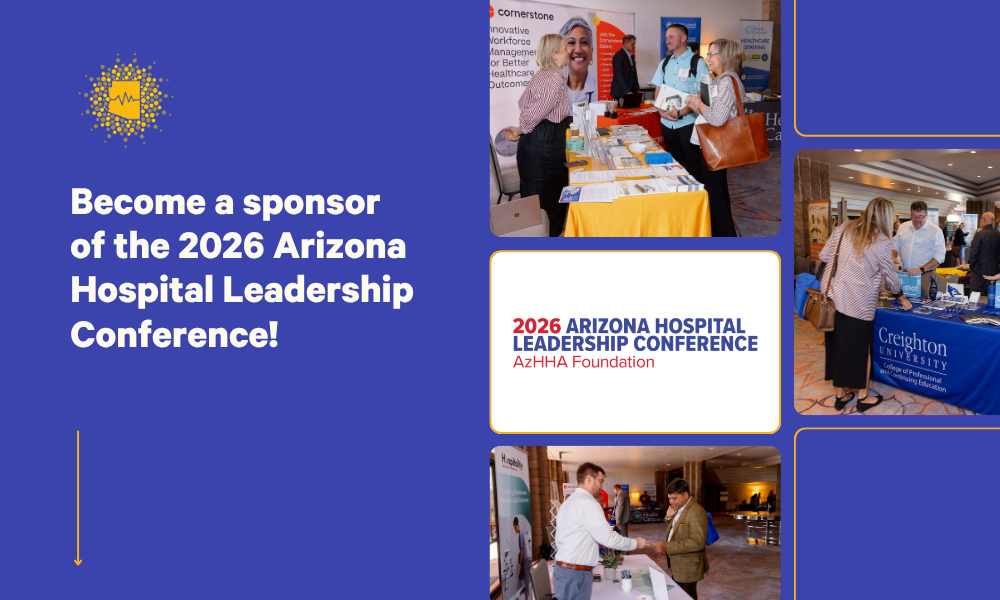
Sponsorship information for the 2026 Arizona Hospital Leadership Conference
Join this year’s Sponsorship Program for the 2026 Arizona Hospital Leadership Conference, Oct. 21-23 in Tucson, Ariz., and have the enhanced ability to reach more than 200 hospital and healthcare industry leaders.
Choose from bundled options at the Platinum, Gold or Silver level, or select an a la carte Bronze option.
The big picture: By sponsoring the AzHHA Foundation’s 2026 Arizona Hospital Leadership Conference, you will have opportunities to:
Gain corporate exposure and brand visibility with healthcare decision-makers.
Secure exclusive, high-impact networking time with hospital executives in an intimate setting to build meaningful connections.
Attend conference sessions, including keynote and breakout sessions on Thursday and Friday.
Achieve insight into Arizona’s healthcare community, including strengths and issues.
Support hospitals’ delivery of quality care.
Go deeper: View the entire prospectus here and access the Intent to Sponsor Form here.
AzHHA’s Shannon Garcia served as a panelist at the recent national AIM Conference
AzHHA's Shannon Garcia (second from right) participates in a panel discussion at the national AIM Conference.
Shannon Garcia, director of maternal health at AzHHA, recently represented Arizona on the national stage at the Alliance for Innovation on Maternal Health (AIM) Conference, which brings together maternal health leaders from across the country.
Shannon served as a featured panelist alongside representatives from Michigan (Dawn Shanafelt) and Texas (Dr. Christina Davidson).
The session focused on state-level approaches to advancing AIM bundle implementation, strengthening hospital participation and aligning AIM efforts with perinatal levels of care to enhance quality improvement initiatives.
Shannon highlighted Arizona’s collaborative approach, emphasizing the importance of strong partnerships among hospitals and with the Arizona Perinatal Trust (APT).
She shared updates on the state’s ongoing efforts to expand AIM bundle adoption, support facilities with data submission and deepen collaboration with APT to ensure meaningful and sustainable impact.
Her remarks underscored AzHHA’ s commitment to meeting facilities where they are, providing tailored support and fostering a culture of continuous improvement.
The big picture: Shannon’s participation in the AIM Conference reinforces AzHHA’ s leadership in advancing maternal health initiatives and its dedication to improving outcomes for mothers and birthing individuals across Arizona.
Through continued collaboration and innovation, Arizona remains well-positioned to build on this progress and drive meaningful, lasting change.
AzHHA releases DataGen reports
In relationship with DataGen, AzHHA distributes reports to hospitals based on information submitted to the Centers for Medicare and Medicaid Services. DataGen generates hospital-specific reports which are sent to AzHHA hospital members as part of their membership.
Why it matters: This data helps hospitals understand the financial impact of proposed changes and annual updates.
The reports can also assist in preparing budgets or benchmarking results with other similar organizations.
The below reports were recently sent to members:
FFY2028 Preliminary Wage Index Analysis (sent Friday, June 12, 2026)
1Q2026 Financial Indicators Analysis (sent Wednesday, June 17, 2026)
1Q2026 Hospital Acquired Condition Reduction Program Analysis (sent Thursday, June 18, 2026)
1Q2026 Quality Program Measure Trends Analysis (sent Tuesday, June 23, 2026)
UPCOMING EVENTS
Friday, July 17, 2026 - 2026 Summer State of the State Registration is now open for The Hertel Report’s Summer State of the State, hosted this year at Summit Regional Medical Center in Show Low, with virtual attendance also available. The bi-annual conference will feature updates on Arizona’s healthcare market and insights on federal and state policy impacts, including Medicare Advantage, Medicaid, the Marketplace and value-based care trends. Discounted pricing is available for AzHHA members by using “azhha2026.” Register now.
Tuesday, Sept. 1, 2026 - Sidewalk to Bedside: Reimagining Care Through Street Medicine-Hospital Partnerships Symposium Join the University of Southern California for a free, in-person one-day symposium. This event brings together street medicine experts, hospital leaders, community organizations and health plans to explore how street medicine programs and hospitals can better partner to improve care before and after hospital discharge. Learn more and register.
Save the Date: 2026 Arizona Hospital Leadership Conference Mark your calendar for the AzHHA Foundation’s 2026 Arizona Hospital Leadership Conference, taking place Oct. 21–23 at the El Conquistador Tucson, a Hilton Resort. This annual gathering brings together hospital and healthcare leaders from across the state for engaging discussions, networking and forward‑focused learning. Additional details and registration information will be shared soon. Questions may be directed to communications@azhha.org.