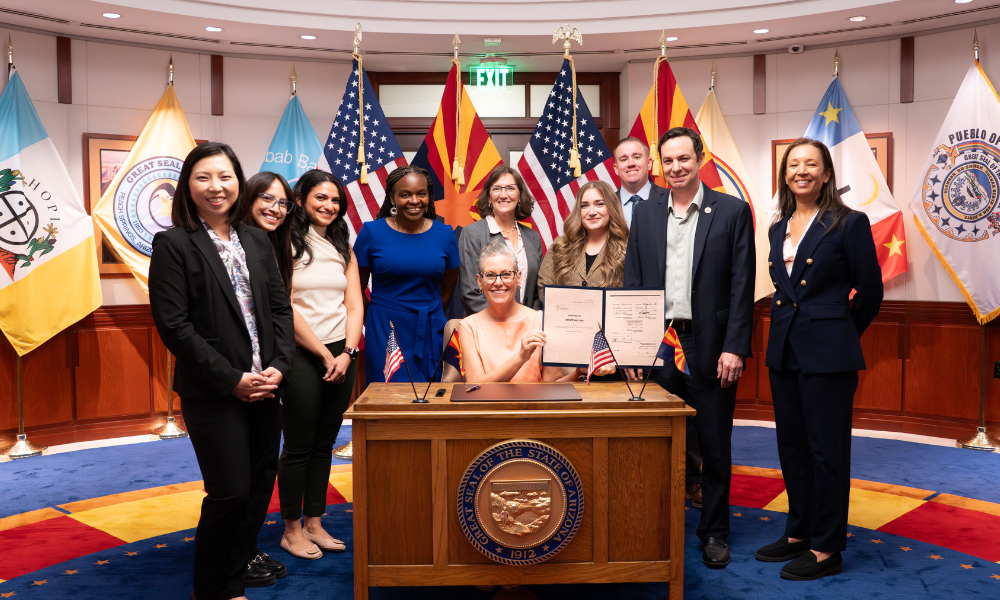
The governor signing SB1253 to close a Safe Haven gap.
Saving on registration for the 2026 Arizona Hospital Leadership Conference.
CMS proposing Medicaid tax provider changes.
Governor signs SB1253, closing a Safe Haven gap
Governor Katie Hobbs held a ceremonial signing of SB1253 (safe haven providers; hospital deliveries) on Tuesday, July 14, 2026, giving Arizona hospitals clear authority to accept a newborn surrendered right after birth.
Why it matters: Hospitals already serve as the front door of the Safe Haven system. The law removes a barrier that could force a parent in crisis to be discharged and return before surrendering.
How it works:
A parent who gives birth at a general or rural general hospital can surrender the newborn to a medical staff member immediately after birth.
The hospital takes custody. No requirement to leave and come back.
Anonymity protections stay intact.
The bottom line: A cleaner statutory protocol for one of the hardest moments a care team faces.
Register today and save: 2026 Arizona Hospital Leadership Conference
Register now to take advantage of the early bird discount. The discount is available until Wednesday, Sept. 2, 2026.
The big picture: This educational event is dedicated to supporting a vibrant healthcare delivery system, including a robust network of acute care, critical access, behavioral health and post-acute care hospitals.
This will be an inspirational gathering of more than 200 hospital and healthcare executives seeking opportunities for continuing education, meaningful discussion and relationship building.
What’s happening: The Centers for Medicare and Medicaid Services (CMS) released a proposed rule that would change how states use healthcare provider taxes to finance Medicaid.
Why it matters: The proposal could affect Medicaid funding, provider payments and access to care in Arizona.
Key changes include:
Replacing the current 6% hold-harmless threshold with state- and provider-specific limits.
Reducing allowable thresholds for Medicaid expansion states beginning in fiscal year 2028.
Eliminating the alternative “75/75” compliance test.
Expanding CMS oversight of taxes on health insurers.
What’s next: Comments will be due 60 days after publication in the Federal Register.
AzHHA is reviewing the proposal and will share additional analysis and opportunities for member input.
SB1291 credentialing reforms are now live
SB1291 (health insurers; provider credentialing; claims), passed in 2025 with a delayed effective date of Tuesday, March 31, 2026, tightens how commercial insurers credential providers and creates a new way to get paid during the contracting gap.
The scope: These rules apply to Department of Insurance and Financial Institutions regulated commercial (fully insured) plans.
Why it matters: Faster, enforceable timelines and payment for care delivered before a contract is signed, but there's a disclosure duty your teams must follow.
The key changes:
Seven-day check. Insurers must confirm completeness within seven days of receiving an application. If they miss the deadline, the application is deemed complete. They can pause the clock for missing information no more than three times.
60 days to credential. Once an application is deemed complete, insurers have 60 days to complete credentialing.
30 days to load. After credentialing is finalized, insurers have 30 days to add the provider to their billing system.
Paid during the process. Requires in-network payment for covered services delivered between complete application confirmation and contract execution. Claims filed within a year of service cannot be denied as late.
Yes, but: Before a non-credentialed provider treats a patient at a network facility, they must provide the patient with a written, dated notice that identifies the billing provider, states the estimated cost and indicates that the provider is not yet credentialed or contracted.
What we need from you: Tell us if you have experienced delays, denials or confusion with credentialing since Tuesday, March 31, 2026. Contact Damien Johnson at djohnson@azhha.org.
Court blocks unilateral 340B rebate models
What happened:A federal court ruled that drug manufacturers cannot require 340B providers to use rebate models unless the U.S. Department of Health and Human Services (HHS) approves them.
Why it matters: The decision reinforces HHS’ authority to administer the 340B program and prevents manufacturers from independently changing how covered entities access discounted drugs.
The bottom line: The court upheld HHS’ rejection of rebate models proposed by Novartis and Johnson & Johnson.
It did not rule on whether HHS could approve a rebate model in the future.
The American Hospital Association and other national hospital groups filed a joint brief supporting HHS’ position.
Hospital CFOs prepare for financial strain as Medicaid cuts threaten coverage
Health systems nationwide brace for financial strain as Medicaid coverage faces significant cuts.
Why it matters: Millions may lose Medicaid coverage due to reduced federal funding and tighter eligibility, increasing uncompensated care for hospitals.
Hospitals serving low-income patients could face billions in additional costs.
What they’re doing: Health systems are investing in strategies to help patients maintain coverage.
Examples include enrollment assistance, financial counseling and community partnerships.
Technology investments like AI and patient navigation programs aim to enhance operational efficiency.
The bottom line: Balancing financial sustainability with care provision remains a key challenge for healthcare leaders, even as they strive to ensure continued patient access despite changing coverage landscapes.
From stabilizing bill rates to evolving labor laws, the healthcare workforce continues to change — and staying ahead of the curve is more important than ever.
National and regional bill rate trends across physicians, advanced practice, nursing, allied health and therapy to support budgeting and sourcing decisions.
A focused workforce briefing covering legislation and policy and market signals.
Why it matters: Whether you’re navigating contract labor challenges today or planning for tomorrow, this report provides the insights you need to make informed decisions.
To connect with an Adaptive Workforce Solutions representative, email Tony Lehman.
What over 106,000 patient access calls reveal about physician availability
3Dhealth, an AzHHA affiliated partner, recently published an article examining whether physician networks are truly open - using insights from real patient access calls.
Why it matters: Health systems often assume their networks are open because providers appear active in directories or on rosters. But call-level data tells a different story.
Directory accuracy is a lagging indicator. Physician availability changes frequently; new patient volume, panel preferences, payer mix and practice circumstances shift continuously.
The primary care closure rate is four times that of specialists.
When access fails, patients are rarely redirected to alternatives, meaning health systems can unintentionally lose care opportunities.
For questions or more information, please contact Ron Flower at rflower@3Dhealthinc.com. To schedule an appointment with Ron, please contact Annalisa Reese at areese@3Dhealthinc.com.
New CME: Dementia diagnosis and management for PCPs
A free, one-hour CME teaches practical, evidence-based strategies to recognize, diagnose, communicate, manage symptoms and coordinate care for patients with dementia.
Why it matters: Dementia risk after age 55 is approximately 42%, making it one of the most common conditions primary care providers (PCPs) will manage.
What’s next: Learn more about the course and how to register here.
UPCOMING EVENTS
Wednesday July 29, 2026 and Thursday, Aug. 6, 2026: DataGen webinar series for members These webinars are intended to provide an overview of the various reports members receive and also share state-specific impacts over the last few years of the programs. Register for the Overview of Medicare’s Value-Based Purchasing Program and Analysis for AzHHA on July 29. Register for the Overview of Medicare’s Readmission Reduction and Hospital Acquired Reduction Programs and Analyses for AzHHA on Aug. 6.
Thursday, July 30, 2026 – AzHHA hosts MBQIP peer learning call This webinar will highlight areas for improvement and identify areas that need additional support based on recent Medicare Beneficiary Quality Improvement Project (MBQIP) and Hospital Consumer Assessment of Healthcare Providers and Systems (HCAHPS) reports that were sent to critical access hospital (CAH) members. Join the meeting here.
Tuesday, Sept. 1, 2026 – Sidewalk to Bedside: Reimagining Care Through Street Medicine-Hospital Partnerships Symposium Join the University of Southern California for a free, in-person one-day symposium. This event brings together street medicine experts, hospital leaders, community organizations and health plans to explore how street medicine programs and hospitals can better partner to improve care before and after hospital discharge. Learn more and register.
Oct. 21-23 – 2026 Arizona Hospital Leadership Conference The 2026 Arizona Hospital Leadership Conference will be held at the El Conquistador Tucson, a Hilton Resort on Oct. 21-23. This will be an inspirational gathering of more than 200 hospital and healthcare executives seeking opportunities for continuing education, meaningful discussion and relationship building. Registerby Wednesday, Sept. 2, 2026, to receive the early bird discount.