AzHHA submitting comments on FFY 2027 assessments and HEALTHII.
How community engagement requirements are moving toward implementation as states await key federal guidance.
CMS releasing a proposed rule on Medicaid state directed payments.
AzHHA submits comments on FFY 2027 assessments and HEALTHII
Last week, AzHHA submitted a second comment letter on the proposed FFY 2027 hospital assessment and HEALTHII payment model.
Why it matters: AzHHA is pushing for greater transparency and meaningful hospital input as the Arizona Health Care Cost Containment System (AHCCCS) finalizes FFY 2027 policies and begins planning for major changes in FFY 2028.
AzHHA is urging AHCCCS to hold multiple, structured workgroups instead of limited meetings.
Hospitals need early financial modeling to plan for federal changes and future payment shifts.
Strong safeguards and collaboration are critical as the state considers moving to claims-based payments.
The bottom line: Without better transparency and collaboration, hospitals face increased financial risk, with potential impacts on services, workforce and access to care.
Also notable: AzHHA again raised concerns about the specialty hospital methodology change, citing significant unintended financial impacts and limited stakeholder engagement and urged AHCCCS to revisit the policy.
Community engagement requirements move toward implementation as states await key federal guidance
Implementation of the Medicaid community engagement requirements enacted under H.R. 1 is moving quickly from policy debate to operational reality, with states preparing for a Jan. 1 federal deadline and the Centers for Medicare and Medicaid Services (CMS) expected to issue major implementation guidance on June 1.
KFF’s Medicaid Work Requirements Tracker will be a key tool for states, providers and policymakers to monitor rollout, including state-by-state data on implementation timelines, enrollment trends, renewal outcomes, application processing, exemptions and unresolved operational issues.
The tracker may become particularly useful because STAT recently reported that CMS may not separately track coverage losses attributable specifically to work requirements versus procedural disenrollments or renewal-related losses.
Operationalization of exemptions is emerging as one of the most challenging aspects for states.
For example, analysts are warning that behavioral health patients and medically complex populations could face significant coverage risk if states adopt narrow or administratively burdensome definitions of the medically frail exemption.
KFF has found that most states plan to adopt the optional hardship exception for individuals living in counties with unemployment rates at or above 8%, or at least 1.5 times the national average unemployment rate.
A new KFF report concludes that although 1.4 million Medicaid expansion enrollees nationally live in counties that could qualify under current unemployment thresholds, only 133 counties in 22 states currently meet those standards.
KFF has identified several additional unresolved operational issues that could significantly affect implementation, including how states will verify compliance, use “reliable information” and external data matching, administer other exemptions and coordinate six-month renewals with community engagement checks.
AHCCCS has begun operationalization but appears to be awaiting additional federal guidance before finalizing several major operational decisions.
AHCCCS has launched an H.R. 1 implementation FAQ page, issued a procurement for communications and outreach related to community engagement requirements and six-month renewals, and is coordinating with DES as Medicaid, SNAP and TANF systems could work together to reduce paperwork burden and verify compliance.
Arizona has not yet publicly confirmed whether it will adopt the optional unemployment hardship exemption.
CMS releases proposed rule on Medicaid state directed payments
On Wednesday, May 20, 2026, the Centers for Medicare and Medicaid Services (CMS) released a proposed rule outlining how it will implement new federal limits on Medicaid state directed payments (SDPs) under P.L. 119‑21 (H.R. 1).
The proposal also includes additional changes that further restrict how SDPs are structured and paid.
Why it matters: Arizona has not meaningfully increased base Medicaid hospital rates since the Great Recession.
To offset these low rates, the Arizona Health Care Cost Containment System (AHCCCS) relies heavily on SDPs, including HEALTHII, DAP, APSI and the Pediatric Services Initiative. Together, these programs provide more than $3 billion annually to Arizona hospitals.
What the proposal does: The rule would significantly constrain SDPs over time:
Caps payments at Medicare rates
100% of Medicare in expansion states like Arizona
110% in non-expansion states
If no Medicare rate exists, payments are capped at 100% of Medicaid
Phases down existing SDPs
Grandfathered programs reduced by 10% annually beginning in 2028
Expands limits beyond the statute
Applies Medicare-based caps to all SDP services beginning in 2029
Extends similar limits to targeted fee-for-service payments
Restricts SDP design
Prohibits uniform increases beginning in 2028
Increases federal oversight of payment structures
The bottom line: Arizona relies heavily on SDPs — particularly HEALTHII — to supplement low base rates. This proposal would:
Reduce Medicaid funding over time as payments are phased down.
Limit the state’s ability to design targeted payment programs.
Affect multiple initiatives, including HEALTHII, DAP, APSI and the Pediatric Services Initiative.
These changes begin in 2028 and coincide with federal requirements to incorporate SDPs into managed care rates starting on Oct. 1, 2027.
⚠️Last chance: Apply now for the 2026 AzHHA Quality Awards
Showcase your work: TheFourth Annual AzHHA Quality Awards provides an opportunity for member hospitals and healthcare facilities to highlight a recent project, within the last 12 months, in:
Outstanding Patient/Community Impact
Workforce Engagement
A Top Overall Excellence Award will also be presented.
Why it matters: These awards celebrate and recognize Arizona’s leaders committed to advancing healthcare with exceptional quality performance, community engagement and a culture of continuous improvement.
The deadline for submissions isat 5 p.m. on Friday, May 29, 2026.
What’s next: The outstanding achievements will be honored at the AzHHA Quality Awards Luncheon on Wednesday, Oct. 21, 2026, during the 2026 Arizona Hospital Leadership Conference.
2026 Member Survey is live!
AzHHA has launched its annual member survey.
This survey is for CEOs of member hospitals only.
Why it matters: The survey helps us understand if we are meeting the needs of our members with policy and advocacy work as well as additional services and programs.
The big picture:
The survey will run until 5 p.m. on Wednesday, June 10, 2026.
All CEOs of AzHHA member hospitals received the survey link via email on Wednesday, May 27, 2026.
It will take no more than five minutes to complete.
What’s next: If you are in the target audience for this survey, please check your email for the direct link to the survey and share your feedback.
This year’s AzCHER Healthcare Emergency Preparedness Conference will be held June 9-10 at the Desert Willow Conference Center in Phoenix, Ariz.
The theme is “Many voices, one mission: Advancing healthcare preparedness together.”
Why it matters: This year’s one-and-a-half-day conference features sessions shaped by member feedback and brings together experts across healthcare, public health and emergency management.
Topics include workplace violence, behavioral threat assessment, regulatory updates, lessons learned and coordinated response.
Day two offers in-depth workplace violence and active-shooter preparedness training, including targeted instruction and hands-on exercise development to strengthen prevention, response and recovery in healthcare settings.
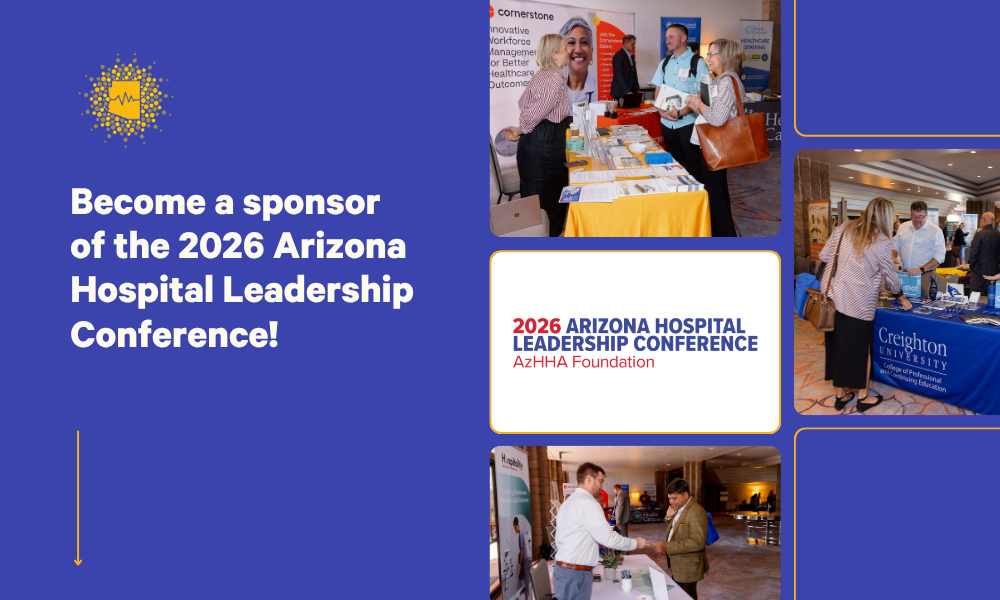
Sponsorship information for the 2026 Arizona Hospital Leadership Conference
Join this year’s Sponsorship Program for the 2026 Arizona Hospital Leadership Conference, Oct. 21-23 in Tucson, Ariz., and have the enhanced ability to reach more than 200 hospital and healthcare industry leaders.
Choose from bundled options at the Title, Quality Awards Luncheon, Platinum, Gold or Silver level, or select an a la carte Bronze option.
The big picture: By sponsoring the AzHHA Foundation’s 2026 Arizona Hospital Leadership Conference, you will have opportunities to:
Gain corporate exposure and brand visibility with healthcare decision-makers.
Secure exclusive, high-impact networking time with hospital executives in an intimate setting to build meaningful connections.
Attend conference sessions, including keynote and breakout sessions on Thursday and Friday.
Achieve insight into Arizona’s healthcare community, including strengths and issues.
Support hospitals’ delivery of quality care.
Go deeper: View the entire prospectus here and access the Intent to Sponsor Form here.
AzHHA releases DataGen reports
In relationship with DataGen, AzHHA distributes reports to hospitals based on information submitted to the Centers for Medicare and Medicaid Services. DataGen generates hospital-specific reports which are sent to AzHHA hospital members as part of their membership.
Why it matters: This data helps hospitals understand the financial impact of proposed changes and annual updates.
The reports can also assist in preparing budgets or benchmarking results with other similar organizations.
FFY 2027 Long Term Care Hospital Proposed Impact Analysis (sent Thursday, May 21, 2026)
UPCOMING EVENTS
June 9-10, 2026 - 2026 AzCHER Healthcare Emergency Preparedness Conference This year’s theme is “Many voices, one mission: Advancing healthcare preparedness together.” The one-and-a-half-day conference features sessions shaped by member feedback and brings together experts across healthcare, public health and emergency management. Register now.
Friday, June 12, 2026 - AzPHA Convos & Coffee: Trends in Cancer Screening Among Arizona Medicaid Enrollees, 2018-2024 Join the Arizona Public Health Association (AzPHA) for a virtual discussion with Gloria D. Coronado, Ph.D. Explore how the pandemic and updated screening guidelines have shaped cancer screening trends among Arizona’s Medicaid population. Register here.
Save the Date: 2026 Arizona Hospital Leadership Conference Mark your calendar for the AzHHA Foundation’s 2026 Arizona Hospital Leadership Conference, taking place Oct. 21–23 at the El Conquistador Tucson, a Hilton Resort. This annual gathering brings together hospital and healthcare leaders from across the state for engaging discussions, networking and forward‑focused learning. Additional details and registration information will be shared in the coming months. Questions may be directed to communications@azhha.org.