How we’re nearing the end of the Arizona Legislative Session.
AzHHA submitting IPPS and LTCH comment letters to CMS.
How prior authorization is inconsistent across insurers.
The end is near
The Arizona Legislature is back in full swing this week.
The executive branch and the legislature worked through the weekend to finalize a budget deal, and the latest budget reconciliation bills were dropped late Tuesday evening. More on that below.
What about our bills? Both chambers kicked off marathon floor sessions on Monday to move stagnant bills forward. Here's where our priorities stand:
SB1162 (health care institutions; licensing; compliance) passed its final reading in the Senate 28-1 and is headed to the Governor's desk. The bill includes a critical amendment that clearly defines behavioral health techs, enabling proper supervision of these roles and improving patient care flow across behavioral health hospitals statewide.
As of Tuesday morning, SB1628 (claims denial; prior authorization; reporting) remains stuck in Rules. We are pursuing every available avenue to move it out, but the outcome is uncertain given the possibility of sine die this weekend.
HB2176 (health facilities; licensure; complaints; investigations) was signed into law late last week — another significant win for regulatory reform at the Arizona Department of Health Services. The bill limits compliance inspections and initial complaint investigations to alleged violations occurring within 12 months of the complaint's submission date, except for complaints alleging abuse.
What's in the budget proposal? Our team had limited time to review the budget before this article went out. Below are the high-level items heading into Joint Appropriations Committee negotiations on Wednesday:
Eliminates the $100 million Hospital Assessment Fund transfer beginning after the current fiscal year
Continues the $12 million total funds CAH supplemental payment as one-time funding
Adds $51.5 million for the Arizona Health Care Cost Containment System (AHCCCS) and $10.8 million for Department of Economic Security (DES) as one-time non-lapsing funding for H.R. 1 implementation
Establishes, conditional on federal approval, a three-year pilot program for coverage of conditional healing services
Removes $11.5 million total funds in one-time graduate medical education (GME) funding but extends the current appropriation through Dec. 31, 2026
Conforms to several H.R. 1 tax provisions, reducing Arizona revenue by an estimated $1.4 billion over four years
Establishes the Arizona Rural Health Transformation Fund as a non-appropriated AHCCCS fund for federal grants, requiring three public meetings and JLBC reporting before expenditures
Tightens verification requirements for AHCCCS and SNAP eligibility
Adds 7 FTEs to AHCCCS for ongoing fraud enforcement
Applies a 2.5% reduction to most state agencies; AHCCCS, Department of Child Safety (DCS) and DES are excluded (one-time)
Requires DES to submit a report by June 30, 2027, on improving the quality and timeliness of eligibility determinations, including goals, actions and barriers
Requires DES to report by June 30, 2027, on anticipated error rates and to provide monthly SNAP reporting through FY 2027 covering investigations, fraud referrals, improper payments, recoveries and related metrics
What’s next: Watch for an AzHHA member call once the legislature adjourns sine die — we'll get that scheduled as soon as the session wraps, with a full update on final legislative action and what made it through the budget.
In the meantime, our team is here to answer questions and hear any concerns. Feel free to reach out to DJohnson@azhha.orgdirectly.
IPPS and LTCH comment letters submitted to CMS
On Monday, June 8, 2026, AzHHA submitted comment letters to the Centers for Medicare and Medicaid Services (CMS) on the FY 2027 proposed rules for the inpatient prospective payment system (IPPS) and long-term care hospitals (LTCHs), raising concerns about payment adequacy, structural pressures and operational impacts.
Top issues raised — IPPS:
Payment updates lag behind rising labor, supply and patient complexity costs, compounding financial pressure on hospitals.
Mandatory nationwide CJR‑X model introduces significant downside risk with limited operational control, especially for rural and resource‑constrained hospitals.
Reductions in DSH and uncompensated care funding may not reflect growing coverage instability and financial need.
Higher outlier thresholds would shift more risk onto hospitals caring for the most complex patients.
Top issues raised — LTCHs:
Payment updates fall short of the cost of caring for high‑acuity patients requiring prolonged, resource‑intensive care.
Structural features of the LTCH payment system continue to reduce capacity and limit access.
Episode-based payment models may discourage appropriate use of LTCH care by incentivizing lower-cost settings.
Proposed shortened quality reporting timeline would create operational challenges and increase the risk of inaccurate data.
Why it matters:
Gaps between payment updates and actual costs compound over time and threaten hospital sustainability.
Policy changes may reduce access to appropriate care settings for medically complex patients.
New models and requirements increase financial risk and administrative burden without clear patient benefit.
Prior authorization inconsistent across insurers
A May research report in Annals of Internal Medicine reviewed prior authorization (PA) rules across three major commercial insurers — Aetna, Humana and UnitedHealthcare — and found significant variation, with little consistency or transparency.
Findings:
Of the 4,645 services requiring PA from at least one insurer, only 14% overlapped across all three insurers.
About two-thirds of services required PA from just one insurer.
Requirements vary significantly by payer, with no consistent standard.
Criteria differ widely, with each insurer using different triggers (e.g., site of care, diagnosis, cost, patient age).
Why it matters: The lack of alignment adds complexity for providers and contributes to administrative burden. It also creates uncertainty for patients, as access to care can vary depending on the insurer — not just clinical need.
Coverage ≠ access: New survey highlights gaps in access and affordability
The Commonwealth Fund’s 2025 Affordability Survey. reinforces a familiar theme: Having coverage doesn’t always mean getting timely, affordable care.
Denials are showing up as delays, stress and real financial consequences for patients.
Why it matters: Denials aren’t just administrative — they’re affecting when patients get care, how sick they become and what they ultimately owe.
For providers, these dynamics often translate into more complex care needs, increased administrative burden and greater pressure on patient financial assistance and bad debt.
The big picture:
Survey of 4,589 privately insured adults (employer + Affordable Care Act/individual)
Fielded July-October 2025
Focused on two types of denials:
Prior authorization (before care)
Claim denials (after care)
What they found:
Coverage denials are widespread.
1 in 5 (21%) adults reported that they or a family member experienced a coverage denial in the past year.
Access to care is affected.
41% said prior authorization denials delayed care.
28% said their condition worsened as a result.
Over 60% reported worry or anxiety tied to denials.
Financial strain persists — even with insurance.
Nearly 70% said claim denials increased costs.
43% reported medical debt tied to a denial.
Appeals remain a barrier.
Only about half of patients appealed.
Many cited confusion about their rights and how to navigate the process.
The bottom line: Insurance coverage is not consistently translating into access or affordability — raising ongoing concerns for patients, providers and policymakers alike.
Sponsorship information for the 2026 Arizona Hospital Leadership Conference
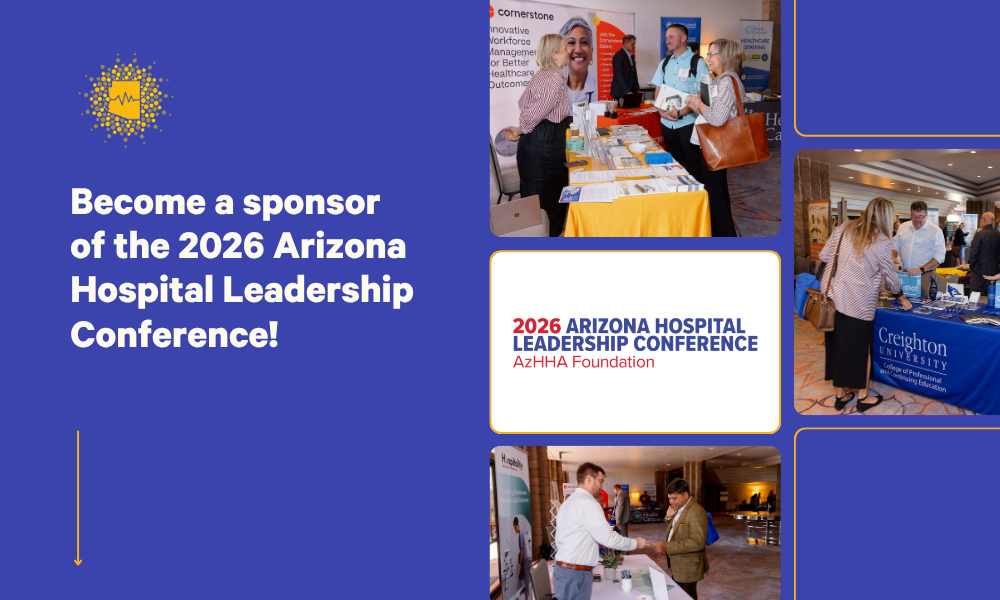
Join this year’s Sponsorship Program for the 2026 Arizona Hospital Leadership Conference, Oct. 21-23 in Tucson, Ariz., and have the enhanced ability to reach more than 200 hospital and healthcare industry leaders.
Choose from bundled options at the Platinum, Gold or Silver level, or select an a la carte Bronze option.
The big picture: By sponsoring the AzHHA Foundation’s 2026 Arizona Hospital Leadership Conference, you will have opportunities to:
Gain corporate exposure and brand visibility with healthcare decision-makers.
Secure exclusive, high-impact networking time with hospital executives in an intimate setting to build meaningful connections.
Attend conference sessions, including keynote and breakout sessions on Thursday and Friday.
Achieve insight into Arizona’s healthcare community, including strengths and issues.
Support hospitals’ delivery of quality care.
Go deeper: View the entire prospectus here and access the Intent to Sponsor Form here.
UPCOMING EVENTS
Friday, June 12, 2026 - AzPHA Convos & Coffee: Trends in Cancer Screening Among Arizona Medicaid Enrollees, 2018-2024 Join the Arizona Public Health Association (AzPHA) for a virtual discussion with Gloria D. Coronado, Ph.D. Explore how the pandemic and updated screening guidelines have shaped cancer screening trends among Arizona’s Medicaid population. Register here.
Friday, July 17, 2026 - 2026 Summer State of the State Registration is now open for The Hertel Report’s Summer State of the State, hosted this year at Summit Regional Medical Center in Show Low, with virtual attendance also available. The bi-annual conference will feature updates on Arizona’s healthcare market and insights on federal and state policy impacts, including Medicare Advantage, Medicaid, the Marketplace and value-based care trends. Discounted pricing is available for AzHHA members by using “azhha2026.” Register now.
Tuesday, Sept. 1, 2026 - Sidewalk to Bedside: Reimagining Care Through Street Medicine-Hospital Partnerships Symposium Join the University of Southern California for a free, in-person one-day symposium. This event brings together street medicine experts, hospital leaders, community organizations and health plans to explore how street medicine programs and hospitals can better partner to improve care before and after hospital discharge. Learn more and register.
Save the Date: 2026 Arizona Hospital Leadership Conference Mark your calendar for the AzHHA Foundation’s 2026 Arizona Hospital Leadership Conference, taking place Oct. 21–23 at the El Conquistador Tucson, a Hilton Resort. This annual gathering brings together hospital and healthcare leaders from across the state for engaging discussions, networking and forward‑focused learning. Additional details and registration information will be shared soon. Questions may be directed to communications@azhha.org.